Fixed, a Film Review

A couple of weeks ago I went to a science conference called S.NET here in Boston. On the first day a film called Fixed was shown, followed by a discussion with the Director. The film was about commonly held beliefs about ‘disability’, and technological ‘fixes’ seen through the eyes of a series of people who use these fixes or work in the field. See the film website here.

My first post on Technology Bloggers was about elective amputation, and in that post I wanted to raise the idea that people may choose to replace parts of their body for better functioning prosthetic devices. This may seem far fetched, but today the US military are a leader in pioneering eye surgery. They operate on pilots with perfect vision in order to make it even better, see this article for a brief overview.

So this leads to questioning the entire idea of able bodied or not. And this is reflected in the title of the film. We are no longer able, now we can take drugs that enhance our learning, have the blemishes in our eyes touched up so that we see better than anyone else, and use body suits that give us super human strength.

It looks to me as if able just got better, but of course how far are we prepared to go? OK, once in a while I might think about helping my brain out a bit with a prescription drug, but of course not every day. Maybe just before my university exams though, and what when the other people in the office start using them every day? I will get left behind so I will have to join them, or should I stand by my ethical convictions and remain disabled?

But back to the film. The protagonists are an interesting lot. One makes bionic limbs, and uses a couple himself after a climbing accident. And he wouldn’t take our second rate skin and bone legs back for a moment! He can climb better, run up the stairs, doesn’t get cramp, can screw on a new foot when he needs different shaped toes, his legs are great.

Another follows one of my great interests, the implications of newly emerging technologies for prenatal screening. One is a test pilot, working for a company that is developing an exoskeleton that allows people with no leg use to walk, another at MIT working on human/machine collaborations, there is a biochemist and somebody who has had sensors fitted to his brain that allow him to use a robot arm through thought.

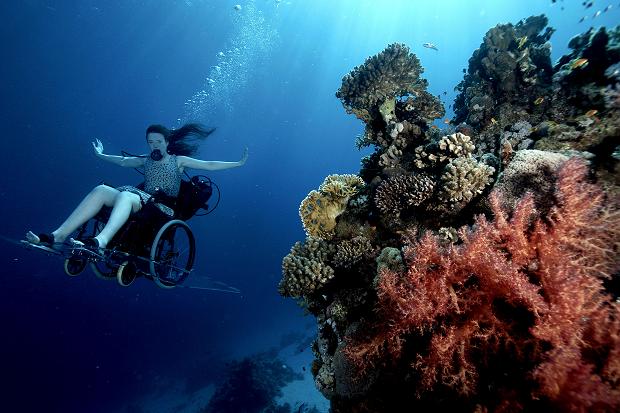
Not to mention the diving wheelchair.
Fixed

Fixed

The film speaks about ‘abelism’, an idea that leads to the possibility of using the dis prefix to describe somebody. The concept is obviously prejudicial and distinctly flawed, particularly today when our able state may not be as natural as we once thought.

There is a field called tranhumanism, more of a movement than a field, that celebrates the dynamic interplay between humanity and the acceleration of technology. There are many websites if you want to search the term. Practitioners see these developments as positive, a brave new future for an old model (the human).

There is a fine line here. Obviously helping someone who cannot walk is a great thing, but we might be moving towards improvement as a model, and no longer at fixing.

I would recommend the film to all. The website linked above has a trailer and list of upcoming screenings, and although it is not yet on general release, I think the film-makers would be pleased to receive contacts. Check out the Trailer here.


The Future of Personal Transport

I am a cyclist myself. I don’t have a car here in the USA, although I do have one sitting on the drive in Italy. The problem with cars is not only that they pollute but also getting stuck in traffic.

When I go out on my bike I know exactly how long it will take me to do my trip, presuming that I have done it before. So I can get to my music lessons in 25 minutes, or to the dentist in 20. If I take a car though sometimes it takes 10 minutes, but sometimes it takes half an hour or more, so I have to leave with ample time to adjust for these problems.

Oh and a million people a year are killed in cars, although biking is certainly no safer. What we need is an alternative, and today for you ladies and gentlemen (and third Gendered) I have started saving up for my answer and dream, a flying car.

The Terrafuggia flying car as a car

The Terrafuggia flying car as a car

No longer the stuff of dreams, local Massachusetts company Terrafuggia are now taking orders for their series of flying cars that will be launched in 2015.

A prototype exists already, and in this CNN video we can see the CEO driving it to the gas station, filling up and taking it for a fly. At a little over $275 000 it may not be in everybody’s price range, but could this seriously change the way we move around in the near future?

I think the USA is the perfect place for such a machine as there are plenty of open spaces for take off and landing, but I can’t see them selling many in Hong Kong or Singapore, or even my home city of Manchester to be honest.

The Terrafuggia flying car as an aircraft

The same Terrafuggia flying car as an aircraft

But returning to the craft itself the spec is interesting. As the website states “the Transition® is the transportation of the future today.  A street-legal airplane that converts between flying and driving modes in under a minute, the Transition® brings a new level of freedom, flexibility, and fun to personal aviation. It gives the pilot the option to land and drive in bad weather, provides integrated ground transportation on both ends of the flight, and fits in a standard single car garage at home.  The Transition® can fly in and out of over 5,000 public airports in the U.S. and is legal to drive on public roads and highways. It is the only light aircraft designed to meet Federal Motor Vehicle Safety Standards, and it is also equipped with a full-vehicle parachute for additional safety”

It can fly 500 miles on a single tank of gas, travels at 100 mph, has automated landing capability, is equipped with a parachute in case of emergencies and you can learn to fly it in less than a day.

The company is also working on an electric vertical take off craft, but this is still in the design stage.

I like the idea, what do you think? No more ice cream for the kids, health club for the wife or golf for me and I reckon that by the time I’m 60 I could buy a second hand one.

Why not try Lightbeam?

I have just downloaded and taken a quick look at the new Mozilla add-on called Lightbeam.

I am an UBUNTU user myself, so I don’t know if this will work for other systems, but I would like you to help me decide if it’s an interesting tool either way.

I have always heard that companies share your information. So you go on one site and they share your habits with other organizations. Well Lightbeam shows you who they are sharing your information with.

One thing that I should say is that I do not know what the information they are sharing actually is. If anyone does know I would love to hear. So that is job number one for you down in the comments below.

The actual view that you are presented with when you open this program is very nice. A series of connected triangles that drift around the screen, all tied together like one of those kinnect toys that my kids play with. Some of the triangles have website logos on them, others are blank. It’s almost a snowdrop kind of effect.

Mozilla Lightbeam

Mozilla Lightbeam screenshot

The lines are either white or blue, the blue depicting that the sites use cookies. Probably half of them do.

And it makes a nice little educational game. As you visit another site it joins the page with its connections, the entity wobbles and bounces before coming static. Many of these connections are the same, creating a central mass, but some sites do not share with anyone that the others do, and live in their own little detached bubble.

I was surprised to find that ebay UK is not connected to any of the other sites. It has 3 satellite sites but they are all ebay subsections. I would have to draw the conclusion that ebay do not share your information. Job number 2, correct me in the comments below please.

The Weather channel divulge to another weather channel and 3 or 4 others, CNN and the BBC are about the same. TECHNOLOGY BLOGGERS DOES NOT SHARE WITH ANYONE! Read it and weep and respect where it is due Christopher. My employer the Bassetti Foundation are linked to Twitter, and nobody else.

Oh and guess who is in the middle of the blob, tentacles everywhere, yes of course, Facebook. I have not visited the site but they appear through the mist to take centre stage. No wonder profits are up!

Without understanding more this add on is just a toy to me, but I am sure if I was a bit more savvy it could give me a lot of insight into the dark and murky workings of the web. I think it might also present an opportunity, as we can now see who is prostituting our information and who is not, and maybe we should put more trust in those that keep our data in their own hands, and some others a little less.

Definitely worth a look I would say.

Oh on a final note, I went to Microsoft, Ubuntu and Mozilla. Microsoft share with 10 satellites, 5 of which use cookies. Ubuntu and Mozilla do not share with anyone. I visited 15 sites in total during my research, and that meant that I unwittingly connected to 76 third party sites.