What would technological innovation look like if its goal wasn’t necessarily to make a profit?

Profit and Growth as an Aim

A simple question to ponder: What would technological innovation look like if its goal wasn’t necessarily to make a profit?

Well that presumes of course that the role of innovation is to boost the economy, which is certainly one of the claims made on many fronts.

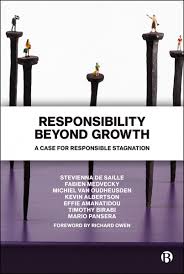
I learned from reading the new book Responsibility Beyond Growth,  A Case For Responsible Stagnation, that the EU funds its innovation with the aim of producing economic growth within the region as part of its Innovation Union program. Innovation for growth! The aim is economic growth in terms of greater GDP across the union.

Which leads to questions about responsibility: Can innovation be responsible if it doesn’t work for economic growth? Can it be responsible if it would lead to a shrinking economy?

Well these seem like simple enough questions if we take them on face value, of course they can, but maybe not if they are funded by businesses or institutions whose aims are economic growth.

But then what about the question at the top, the question raised in the book, how would the innovation system differ if it wasn’t geared towards growth? How does innovation differ today that is not funded with these aims in mind?

Can we draw a comparison within single fields to look for similarities?

Medicine

There have long been arguments that technological developments in medicine have been driven by wealth generation. Malaria is often given as an example. One of the most damaging health issues in the world received around 3 billion US dollars a year for research, control and elimination, but this is less than the 5 billion deemed necessary to reach agreed milestones (We have to take these data on face value as I can’t guarantee they are correct).

Critics argue that this shortcoming is caused by the fact that treatment for malaria (new drugs) will not generate much profit for the global pharmaceutical industry.

If we compare this to some of the figures given for cancer treatment the figures are well over 100 billion per year. Cancer treatments are expensive and lucrative for the drug companies, so economic logic would lead them to investing more in research in this line than in others.

If we extend this thinking to global innovation then the question appears again, how would technology develop if it was decoupled from economics? Would more solutions be found for problems that are under-addressed because there is little profit in the solution (or even loss)?

It’s not such an abstract question if we think about open access publishing and the development of free software (UBUNTU as an example). Some argue that these programs are better than their more widespread cousins, precisely because they are developed by users and for users, not necessarily for shareholders. Could this become a broader argument?

The book I mentioned above goes into much greater detail. Check it out if you can.

Hacker Cultures

EASST

The European Association for the Study of Science and Technology held its annual conference in August, and a veritable feast of information it turned out to be (as is their website).

In particular though I would like to point readers towards a podcast series, based upon a panel held during the conference.

The podcast series is called Hacker Cultures. From the website:

This year, Covid-19 turned most conferences virtual, so to combat Zoom-fatigue, we decided to try another format and turn a conference session into a podcast. This series comes to you from the 2020 joint Society for Social Studies of Science/European Association for the Study of Science and Technology conference, titled “Locating and Timing Matters: Significance and agency of STS in emerging worlds” which took place from August 18th-21st. Among hundreds of panels, papers and sessions, the Hacker Cultures panel rounded up all sorts of researchers who study what it is to be a hacker, and what hacking, programming, tinkering and working with computers is all about. The hosts of this podcast are Paula Bialski, who is an Associate Professor at the University of St. Gallen, and Mace Ojala, a lecturer at the IT University of Copenhagen. On-site recording and production was done by Heights Beats at Hotmilk Records. The theme song is titled “Rocky” by Paula & Karol. Funding for the editing of this podcast comes from the University of St. Gallen.

The episodes are in the style of an interview rather than a lecture, easy to follow and really interesting.

What is on Offer?

Episode 1: Morgan G. Ames – Throwback Culture: The Role of Nostalgia in Hacker Worlds
Episode 2: Minna Saariketo & Mareike Gloss – In the grey zone of hacking? Two cases in the political economy of software and the Right to Repair
 Episode 3: Annika Richterich – Forget about the learning: On (digital) creativity and expertise in hacker-/makerspaces
 Episode 4: Alex Dean Cybulski – Hacker Culture Is Everything You Don’t Get Paid For In the Information Security Industry
 Episode 5: Jeremy Grosman – Algorithmic Objects, Algorithmic Practices
 Episode 6: Stephane Couture – Hacker Culture and Practices in the Development of Internet Protocols
 Episode 7: Ola Michalec – Hacking infrastructures: understanding capabilities of Operational Technology (OT) security workers
 Episode 8: Sylvain Besencon – Securing by hacking: maintenance regimes around an end-to-end encryption standard
 Episode 9: R. Stuart Geiger & Dorothy Howard – ‘I didn’t sign up for this’: The Invisible Work of Maintaining Free/Open-Source Software Communities

Really entertaining, informative and featuring lots of well known experts, 15 to 20 minutes each, well worth a browse.

The Past, 20/20 and FUTURE of ICT Standardisation 2 – 3 September 2020

The Future of ICT Standardization

If you are free this week, why not register for the Standards and Innovation in Information Technology Conference? The event is online, takes place on 2 and 3 September, and is free!

The conference is made up of six online panel discussions on important current topics, featuring lots of well-known experts. Issues addressed will include (but not be limited to) the role of ICT standardization in combatting Covid-19, the question of whether Standardization can help ensure fair competition with the tech giants, global trade and digital trade barriers, Big Data, AI and inclusivity.

This is a conference of the highest level, so it should be extremely informative and provide good debate.

Registration is available here.

Overview of the Panels and Presenters:The Role of ICT Standardisation in Combatting Covid-19


Time and Date: 2 September 2020, 15.30 – 16.30 CEST, 6.30am – 7.30am US PDT
Organiser: Jochen Friedrich, IBM, DE
Panellists:
Emilio Davila Gonzalez, European Commission, BE
Edgar Guillot, Orange (Chair, ETSI E4P project), FR
Jenny Wanger, Linux Foundation, US
Zhou Ping, CESI, CN
Experience panel:
Frank Karlitschek, NextCloud, DE
Alexandre Zapolsky, Linagora, FR

The Future of Intellectual Property and Standards — What Do the Data Tell Us?
Time and Date: 2 September 2020, 17.00 – 18.30 CEST, 8.00am – 9.30am US PDT
Organiser: Jorge Contreras, U. of Utah, US
Panellists:
Justus Baron, Northwestern U., US
Rudi Bekkers, TU Eindhoven, NL
Tim Pohlmann, IPlytics, DE
Tim Simcoe, Boston U., US
Tom Cotter, U. of Minnesota, US

Can API Standardisation Ensure Fair Competition with the Tech Giants?
Time and Date: 2 September 2020, 19.00 – 20.30 CEST, 10.00am – 11.30am US PDT.
Organiser: Ken Krechmer, Isology, US
Panellists:
Joe Decuir, University of Washington, US
Kalle Lyytinen, CWR U., US
David Reed, U. Colorado Boulder, US
Jill Van Matre Dupré, U. Colorado Boulder, US

Standards and Global Trade: TBT vs. Digital Trade Barriers?
Time and Date: 3 September 2020, 15.00 – 16.15 CEST 6.00am – 7.15am US PDT.
Organiser: Donggeun Choi, KSA, KR
Panellists:
Gloria Pasadilla, Leadership Design Studio Pte Ltd., SG
Joshua Paul Meltzer, Brookings Institution, USA
Heejin Lee, Yonsei U., KR
Devin McDaniels, WTO, CH

Big Data and AI Standards as Contributors to UN SDGs
Time and Date: 3 September 2020, 16.30 – 17.30 CEST, 7.30am – 8.30am US PDT (pending confirmation).
Organiser: Ray Walshe, DCU, IE
Panellists:
Ray Walshe – Dublin City University, IE
Paul Foran – Huawei Ireland Research Center, IE
Satyam Priyadarshy, Halliburton, US
Tomas Malik, UNECE, CH (tbc)

Re-designing Standardisation for Inclusivity
Time and Date: 3 September 2020, 18.00 – 19.30 CEST 9.00am – 10.30am US PDT.
Organiser: Carl Cargill, US
Panellists:
Wendy Seltzer, W3C, US
Linda Garcia, Georgetown U., US
Michael Spring, U. Pittsburgh, US