The FDA Shuts Down Home Genetic Testing Company 23andMe

On Monday the US Government FDA forced the main home testing company 23andMe to stop selling its saliva genetics home testing kit. As this is their only product this means that they effectively shut down their operation.
Looking at Genes

Looking at Genes

The problem seems to be that the company is offering testing for gene mutations that may lead to rises in probability of contracting diseases. This is considered a medical test by the FDA, and so they require trials and results in order to see how well the tests work before they license them. 23AndMe have been unable or unwilling to provide such results, so cannot market their device unless they take away all of the medical arguments.

This is the technical reason, but there are serious ethical issues surrounding home genetic testing. The following are just a few of my own ideas:

Without serious research doubt must remain about the quality of the results. The samples are not second tested, and the quality of testing cannot be of the same level as other medical hight cost exams. There have been problems reported due to the small number of people involved in the test groups, as statistics require masses of data that are not yet available.

Are customers qualified to interpret the results? What does a statistical rise in probability actually mean to a person that has never studied statistics or probability? And the results are delivered without any counseling, so if there is bad news the customer is left to process the information alone.

Here just a few examples might demonstrate the difficulty. If I have a 1% chance of contracting problem A, but I have a gene variant that means that I am 70% more likely to contract it, I might be distraught. The reality is that I now have a 1.7% chance, very little difference, but I might try to change my lifestyle, treat my kids differently, get paranoid, have preemptive surgery, who knows how an individual will react without medical advice?

If on the other hand I am negative for a mutation for something I might adopt an equally problematic stance. I don’t have the gene mutation that leads to skin cancer so I can stop worrying and have another hour on the sun bed. Social factors are really the big ones in many cases.

And what about testing your children? How will parents react knowing that their child might be susceptible to certain problems later in life?

Oh and if I discover that I have something hideous, should I tell my brothers? They might carry it and pass it on to their children. How personal is this type of medicine? It is familial, not individual.

The 23andMe problem is a prime example of money ruling. They have operated for 6 years, without regulation and blatantly challenging the FDA and medical profession that they see as holding up progress. As far as I can see this is about as far away from the responsible innovation that I have spent my recent life trying to promote as I would like to see anyone go. I would add though that it is a systemic problem here in the USA, not a personal divisive choice, and it is very different to the European approach underscored by the precautionary principal (with all its critics).

For further reading you will find several of my articles linked through this post on the same subject from last year.

The National Post has a good article too that includes both sides of the argument.
The End of Blockbusters and New Start-ups?

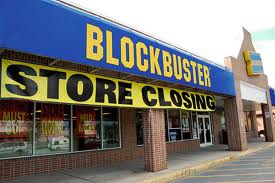
Out with the old and in with the new once more. Last month it was Blockbusters, the global giant of video rentals, closing their last few doors for the last time in the USA, as they filed for bankruptcy. Technology has overtaken them, their model of offering films for rent is obsolete.

Many stores are closing

Many stores are closing

Even in the UK where I grew up there seemed to be one on every corner. I used to walk round of an evening and thumb through the Betamax section (my mum had Betamax, much better quality than VHS, not widely used in a domestic setting but still used today for broadcasting).

For youngsters reading this article, the idea was that you take the film home and watch it and then return it the day after. Yes I know it sounds ridiculous, but if you forgot to return it you paid overdue fees, and these alone made $800 million in the year 2000, and that was less than 20% of the company’s operating profits!

And the rise was incredibly fast. In its first 15 years of operation Blockbuster grew from nothing to more than 9000 stores, even today it still boasts 3000, although they have been losing money hand over fist for more than a decade.

Netflix put an end to the party, but how could such a giant in the entertainment industry miss out on an opportunity to move forward. Back in 2002 they could have bought the Netflix operation for next to nothing, but the then CEO never thought it would take off. How wrong could he be?

Well here in Cambridge Massachusetts they have devised a system in order to try and stay on track with such developments, although I am not sure it is a good one. There is a huge culture of start-up funding, with an entire industry revolving around funding such new ventures.

We have the Mass Challenge competition that gives away more than a million dollars a year, loads of networking meetings and funding workshops. But what are these investors looking for? They are looking for the next Netflix or Amazon obviously, and they are prepared to put large sums of money into anything that looks like it might develop into something of the sort.

There are a lot of start-ups here that manage to spend a million a year for several years without ever turning a profit. A few hundred thousand on lawyers each year, nice office space, public presentations, and the investors keep coming in looking to make a fortune on the next new thing.

Just to give an idea of how much money is invested if we take a look at Mass Challenge they have invested $472 million in the last 4 years, and that has made a return income of $194 million. This investment has created 3928 jobs although we don’t know how many of them exist today.

All well intentioned I am sure but that means they have so far lost $278 million in 4 years. But they have created jobs, although at a cost of almost $71000 each. Not a great return, but we are talking about a not for profit organization investing private money so presumably everyone is happy.

I just wonder whether a more efficient model could be found, while not missing out on the next best thing of course. And I wonder how ethical investment choices are made. We are dealing with huge resources, and resources are the key to shaping the development of society. How much of this money could be said to be invested for the good of society? And how long can this type of approach continue whan 3 out of 4 fail?

I should just add that I use Zipcar, a local car sharing start up, so I don’t want to sound too critical. They have taken many cars off the road, which can only be a good thing. Several other food start ups work for social good, but they feel cut out of the funding cycle. See this post I wrote for IX about their positions.

Fixed, a Film Review

A couple of weeks ago I went to a science conference called S.NET here in Boston. On the first day a film called Fixed was shown, followed by a discussion with the Director. The film was about commonly held beliefs about ‘disability’, and technological ‘fixes’ seen through the eyes of a series of people who use these fixes or work in the field. See the film website here.

My first post on Technology Bloggers was about elective amputation, and in that post I wanted to raise the idea that people may choose to replace parts of their body for better functioning prosthetic devices. This may seem far fetched, but today the US military are a leader in pioneering eye surgery. They operate on pilots with perfect vision in order to make it even better, see this article for a brief overview.

So this leads to questioning the entire idea of able bodied or not. And this is reflected in the title of the film. We are no longer able, now we can take drugs that enhance our learning, have the blemishes in our eyes touched up so that we see better than anyone else, and use body suits that give us super human strength.

It looks to me as if able just got better, but of course how far are we prepared to go? OK, once in a while I might think about helping my brain out a bit with a prescription drug, but of course not every day. Maybe just before my university exams though, and what when the other people in the office start using them every day? I will get left behind so I will have to join them, or should I stand by my ethical convictions and remain disabled?

But back to the film. The protagonists are an interesting lot. One makes bionic limbs, and uses a couple himself after a climbing accident. And he wouldn’t take our second rate skin and bone legs back for a moment! He can climb better, run up the stairs, doesn’t get cramp, can screw on a new foot when he needs different shaped toes, his legs are great.

Another follows one of my great interests, the implications of newly emerging technologies for prenatal screening. One is a test pilot, working for a company that is developing an exoskeleton that allows people with no leg use to walk, another at MIT working on human/machine collaborations, there is a biochemist and somebody who has had sensors fitted to his brain that allow him to use a robot arm through thought.

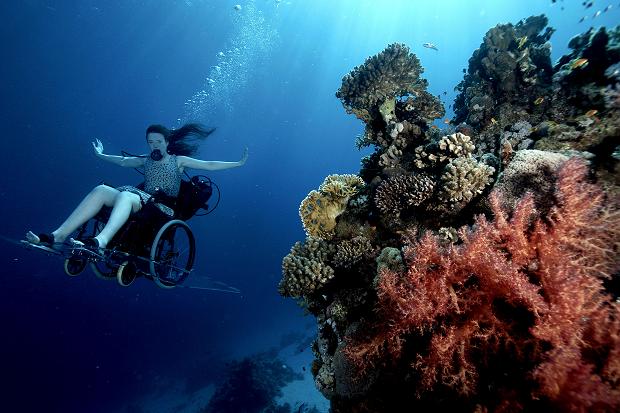
Not to mention the diving wheelchair.

Fixed

Fixed

The film speaks about ‘abelism’, an idea that leads to the possibility of using the dis prefix to describe somebody. The concept is obviously prejudicial and distinctly flawed, particularly today when our able state may not be as natural as we once thought.

There is a field called tranhumanism, more of a movement than a field, that celebrates the dynamic interplay between humanity and the acceleration of technology. There are many websites if you want to search the term. Practitioners see these developments as positive, a brave new future for an old model (the human).

There is a fine line here. Obviously helping someone who cannot walk is a great thing, but we might be moving towards improvement as a model, and no longer at fixing.

I would recommend the film to all. The website linked above has a trailer and list of upcoming screenings, and although it is not yet on general release, I think the film-makers would be pleased to receive contacts. Check out the Trailer here.