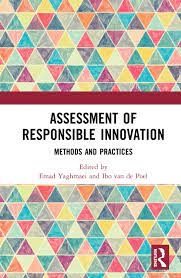
Assessment of Responsible Innovation: Methods and Practices on Free Download

Assessment of Responsible Innovation: Methods and Practices is edited by Emad Yaghmaei and Ibo van de Poel, both well known in the field of Responsible innovation.

As regular readers will know, the EU has funded a long series of projects aimed at building tools and tool kits to help various sectors implement Responsible Innovation Approaches. This collection presents many of these tools while aligning aims with the United Nations sustainable development goals.

The book is divided into three parts.

Part 1. Reflections on Responsible Innovation.

Part 1 offers thoughts and perspectives based on personal experience from working within or alongside some of these projects. We find a historically grounded overview of different approaches and views of responsibility and democracy (and their relationship with scientific processes), and some interesting examples of approaches to networking responsible practices taken across the world.

Part 2. Responsible Research and Innovation (RRI) in Companies.

Part 2 offers 4 chapters that raise lots of interesting questions and issues regarding the relationship between RRI and Corporate Social Responsibility, obstacles and drivers for RRI implementation, costs and benefits from following and RRI approach and possible roles for voluntary standards. 

Part 3. Responsible Innovation Assessment.

This third and final part of the book presents a compendium of different approaches, methods and metrics for assessing responsible innovation practices spread across 8 chapters.

The chapters raise a host of questions regarding which indicators and metrics might be useful if trying to measure effectiveness of RI and RRI processes, which types of assessment could be carried out, opportunities and challenges faced, the volume and depth possible for integrating practices, as well as discussion of pitfalls, all set alongside a series of proposals and a host of suggestions for methodologies that could be followed.

Several of the EU projects I have posted about in the past are mentioned, with their tool-sets and approaches explained and analyzed in easy-to-understand terms. There are some interesting points of focus too, from ICT and digital transformation to employee creativity and reflexive skills.  

The Collection

This collection brings together a broad spectrum of approaches that would otherwise find themselves scattered across project websites, offering the reader an overview of what could be seen as different practices that have grown out of different interests and focusses.

The editors have set out to bring these developments together, and have succeeded in doing so in a very readable and interesting way.   The book is a kind of overview of tool-kits and approaches and practices, a fine companion for anyone interested in Responsible Innovation. Download it here.

Artificial Intelligence for a Better Future

Why not join Bernd Carsten Stahl for the launch of his new Open Access book on Artificial Intelligence for a Better Future on 28 April, at 16:00 CET?

In his new book Artificial Intelligence for a Better Future, An Ecosystem Perspective on the Ethics of AI and Emerging Digital Technologies, Bernd Carsten Stahl raises the question of how we can we harness the benefits of artificial intelligence (AI), while addressing potential ethical and human rights risks?

As many of you will know, this question is shaping current policy debate, exercising the minds of researchers and companies and occupying citizens and the media alike.

The book provides a novel answer. Drawing on the work of the EU project SHERPA, the book suggests that using the theoretical lens of innovation ecosystems, we can make sense of empirical observations regarding the role of AI in society. This perspective allows for drawing practical and policy conclusions that can guide action to ensure that AI contributes to human flourishing.

The one-hour book launch, co-organised by the SHERPA project, Springer (the publisher) and De Montfort University, features critical discussion between author Prof. Bernd Stahl and a high-profile panel featuring Prof. Katrin Amuns, Prof. Stephanie Laulh-Shaelou, Prof. Mark Coeckelbergh, moderated by Prof. Doris Schroeder.

The panel discussion will include a questions and answer session open to members of the audience.

You can find more information about the launch event and register here, and the book can be downloaded here.
If you would like to know more about the author’s work, you can find an introduction to some of his earlier work here.

A Video Interview with In4Art

Artwork from roots, by Diana Scherer

In4Art

In November of last year I introduced readers to the work of Rodolfo and Lija Groenewoud van Vliet.

As the post explains, they founded the In4Art organization (back in 2015) with the mission to increase the impact of innovative art in society and the economy, seeing art as a powerful engine for responsible innovations.

The pair believe that art can act as an accelerator for innovation, as well as offering reflections on our fast-changing high-tech society. By translating that into art-driven innovations they aim to enable impact from economical, ethical, environmental, social and legal perspectives.

From the Website:

The project’s focus is to increase the impact of art in society and economy by bringing systematic change to the domains of circular economy, material research and next generation internet. Care and Environment, a mix of sustainable development goals and positive impact for the broad society.

How do they go about this? Well, In4Art creates space for experiments on the intersection of art, science and technology. It works to translate the outcomes into inspiration, strategic implications and responsible innovations, acting as a partner in the development of artistic prototypes into art-driven innovations and sharing their trans-formative potential, while building a network of forward looking, 21st century thinkers and doers.

The founders have created the  Art-Driven Innovation method, guiding In4Art and its innovation projects, collections, experiments and research, focusing on breakthrough technologies.

The Video Interview

As an investigator I find their approach really interesting, and was fortunate enough to be able to interview them (virtually), and with funding and technical assistance from the Bassetti Foundation (part of our agreement explained here), produce a video interview.

To learn more about their work, the artists and their artistic works (including the roots photo above), and to see me in action, watch the video.