Scientists grow artificial meat

In my work at the Bassetti Foundation I have written extensively about food, its production and how technology has entered and continues to encroach on everyday provisioning.

I wrote an article about how milk from cloned cows entered the food chain last year, and then how some cloned cows went missing in Scotland, probably ending up at the butcher’s shop and on to somebody’s table, but this week I let you in to a story that goes much further.
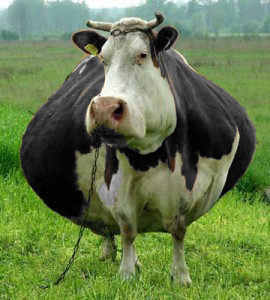
A very fat cow

A fat cow

Scientists in Holland have managed to grow meat from stem cells and later this year aim to have enough to make a hamburger. I don’t know if they plan to eat it though, it will cost about $300 000 to produce. Although this sounds abhorrent as well as quite expensive, they have good reason to try it. Many experts believe that current food provisioning techniques are non sustainable. As the population grows more people require more food, but leave less land to use in its production, and this presents one problem. The second issue is that large scale meat production is one of the biggest carbon producing industries on the planet.

Meat production is also physically very damaging for the environment, there have been many articles written about beef production in Argentina and Brazil causing problems for the rainforests. Meat production is also inefficient. In order to produce meat (for example beef again) you need to feed up a cow, and cows eat a lot. The protein gained from the cow is equal to 15% of the protein it eats, so you have to feed a herd of cows 100 tons of protein for every 15 tons produced.

So could this new type of production help feed the planet? It will certainly have to overcome a few hurdles, production price will have to come down obviously and I imagine protests and general dislike of the idea, but OGM is everywhere nowadays (unmarked in the US I believe) and you can get used to anything if you try. The point is that it can be done, the technology exists and once done on mass it will be done cheaply.

If you are interested in learning more take a look at the article on the BBC website, my interview with Prof Andrew McMeekin of the University of Manchester Business School on the subject of food provisioning and my other meanderings on the Bassetti Foundation website.
What we now know about Facebook

As you may have heard, Facebook plans to become a public limited company (plc) and float on the stockmarket. It hopes that this will raise around the sum of $5 billion USD (this is only about half what most people thought it would try to raise) in finance for the business, a colossal amount!

Facebook's LogoThanks to the flotation it is estimated that around 30% (roughly 1,000 people) of the companies employees will become millionaires! That said, Mark Zuckerberg is reducing his annual salary to just $1 as of January next year. Why? Because he will have shares estimated at the value of around $100 billion!

Anyway, due to Facebook wanting to become a plc, it needed to release more detailed financial data than it ever had before, into the public domain. This means that we now know much more about this previously rather secretive internet giant, than ever before!

Finances

Thanks to its choice to become a plc, we now know that Facebook makes 85% of its income from advertising. Furthermore we know that last year it made almost $4 billion USD! Out of this, it turned an impressive 25% into profit, bringing it in $1 billion (supposedly exactly) in net profit.

It is now possible to value to company as a whole, and it is thought to be worth $100 billion USD. To compare that to other industry giants, Amazon is valued around the same amount, eBay is values at about half that figure, and Google is thought to be worth double that.

Ownership

Facebook will still be owned and controlled largely by Mark Zuckerberg. He currently owns 28.4% of Facebook and has a majority in terms of voting rights with over 50% of votes. Basically Zuckerberg owns Facebook still, and he seems to want to stay in the driving seat for a while yet!

Mark Zuckerberg the founder of FacebookUsers

We now also know that Facebook have around 845 million active users around the world, of whom, around 450 million visit the site very regularly – that is a crazy amount!

The Future?

Facebook would be worth nothing without its users. Some people say that its users are not Facebook’s customers, but in fact the networks products. If people get bored or move on, the site will die.

If you were buying shares in an internet based business, Google would probably be a much safer bet than Facebook, as its future looks much more certain. Facebook may pay massive dividends to investors in the future, or it may go into decline and cost investors a collective $5 billion!


Friends Reunited was once great, now it stands in Facebook’s massive shadow, as does Myspace, Bebo, Foursquare and many other social media sites. All these sites how now been superseded by Facebook, the question is, will Google Plus or something else dwarf Facebook? Personally I believe that in 10 years, there will be something bigger, but we will just have to wait and see 🙂

Google prunes some of its branches

It is that time again at Google when it has to prune some of its various branches. Since Google co-founder Larry Page took over the reins as CEO in April last year, Google has been reducing and trimming its projects to renew and regain focus.

Google has come under investor scrutiny as it is facing increasing competition from both Apple and Facebook.

This spring cleaning is part of the various cost cutting and refocusing efforts. In the latest cleaning exercise announced a few weeks ago, Google will be pulling the plug on seven of its projects.

1. Google Knol

Google launched Knol in 2007 to help improve web content and as a challenge to Wikipedia that enabled experts to collaborate on in-depth articles. Knol will be available till April 30, 2012, to enable users to download their Knols to a file and/or migrate them to the WordPress platform. After that till October 1, 2012, Knols cannot be viewed but users will be able to download and export content. After October 2012, the Knol content will no longer be available.

2. Google Gears

Google has closed the Gears browser extension for creating offline web applications and stopped supporting new browsers in March this year. From December 1, 2011, Gears-based Gmail and Calendar offline will not work across all browsers, and Gears will not be available for download from late December this year. Google announced that this is part of their effort to help incorporate offline capabilities into HTML5. Users can access Gmail, Calendar and Docs offline in Chrome.

3. Renewable Energy

Google has abandoned its ambitious plans to make renewable energy cheaper than coal. Google had started this project in 2007 as a means on driving down the price of renewable energy with a strong focus on solar power. Google announced that the head of the project, Bill Weihl (William E. Weihl) has left the company and it believes that other organizations were in a better position to take its efforts to the next level.

4. Google Wave

Google has earlier stopped further development on Google Wave. Now it has announced that as of January 31, 2012, Wave will be available as only a read-only version and users won’t be able to create new ones. This will be completed closed on April 30, 2012. Users can transfer individual waves using the existing PDF export feature.

5. Google Search Timeline

Google will be removing this feature that displays a historical graph of results for a search query. Users will now be able to restrict any search to particular time periods using the refinement tools on the left-hand side of the search page. Uses who wish to view graphs with historical trends for a web search can use Google Trends or Google Insights for data since 2004. If you need more historical data, the “Ngram Viewer” in Google Books offers the same information.

The Google Trends Product Logo

6. Google Friend Connect

Google Friend Connect, which is a social feature, will be discontinued from March, this is because Google wants people to start using the Google Plus social network instead.

7. Google Bookmarks

The feature will become unavailable from December 19, 2011. This enabled users to share bookmarks and collaborate with friends. The existing bookmark Lists will be retained and labelled to make it easier to identify. The other features of the Google Bookmarks will keep on functioning. The change won’t affect the non-English users as it was an English only feature.

This spring cleaning is only a sign that Google knows that it currently faces big competition, so it needs to make sure that it discontinues disused/inefficient services it provides.