The Future of Paper?

Much has been said and written about the future of paper publications with the arrival of downloadable  books, Kindles and a whole world of other hardware, but maybe a company from Cambridge (UK for a change now I am back in Europe) may be about to cause another revolution.

Many people are not drawn to reading books in digital, they like to thumb the pages etc, but a private company is putting what they describe as the ‘future of paper’ into mass production.

The company called Plastic Logic have designed what we could describe as the closest thing to paper that can show video.

An example of Plastic Logic’s invention

As the name suggests we are talking about a plastic paper-thin sheet that has the ability to display video, It can be used as a Wi-Fi fed screen, with the advantages of being flat, thin, flexible and bigger than your standard reader.

This video on the BBC website describes the product in greater detail, including the production process, and states that it should be in full production next year. The CEO of the company also explains the problems that this technology has faced during development as well as explaining why we might need a screen that we can roll up and carry around. He also describes how the computer and receiver part of the structure could be attached in the form of a handle.

All very interesting stuff, but I think the most important part of this application involves telephones. I have a so-called smart phone but I very rarely use it for internet work because the screen is too small. I cannot read an article on a screen that size. But if I had an A4 size screen rolled up in my bag that could show me the screen on a much larger scale (via Bluetooth) I would be happy to use it. And then I could leave my laptop at home.

Others see it as the future for glossy magazines, or the death of them, but the death of newspapers, radio, books, recorded music and commercial TV has been on the cards for a long time, and they are all still alive and kicking.

I look forward to this new product going into full production and appearing in the shops anyway, and the obvious question…. would you have a use for it?

Sequencing the genome of unborn babies

As a follow on from my post about genetic testing last month, I would just like to point community members towards a story that is just breaking here in the US.

The New York Times carried a story on its front page on 7th June in which it reported that an unborn baby’s DNA was sequenced with 98% accuracy using just the mother’s blood and father’s saliva. The testing was done when the fetus was 18.5 weeks old. The accuracy was tested after the baby was born with a full sequence conducted on blood taken from its cord. A second experiment involving blood taken from a mother much earlier in the pregnancy (8 weeks) showed similar results although slightly less accurate.

non-invasive testing of a fetus now possible

In purely practical terms the authors point out that this system of testing for genetic disease is completely non-invasive, and this will save the lives of many unborn children. Presently amniocentesis or chorionic villus sampling are the preferred means for conducting tests for genetic disorders, but these techniques lead to the loss of the baby in about 1% of all cases as they both require the insertion of a needle.

The ethical implications of such a breakthrough are being widely discussed however. Much of the debate revolves around the idea that parents may choose to abort a fetus because it may not carry the traits they desire, and not only in terms of possible genetic diseases. We all know about the problem of female fetus abortion, and here we are introducing an entire matrix of more or less desirable features. There is also a serious problem of false positives, as some mutations were missed in the experiment and other positives given that at birth were found not to be present.

An argument that recurs involves the identification of diseases that may affect the individual in late life such as dementia. What kinds of decisions are parents of unborn children likely to make if they are told that it carries a mutation in a gene that raises its chance of getting cancer, or dementia or any other typically later life problems?

In this world of information however I imagine that there will soon be a market for such tests in the style of 23andMe, and as the price comes down many people will want to see the probable health future for their unborn children, as well as whether they will be tall or short, blond or brown or have blue eyes. This will have practical consequences for society.

If the model follows the existing 23andme path of offering statistical analysis of the chance of developing diseases in life the problem becomes even more complex. What might the effect be of telling the parents of an unborn child that it has a 40% increased possibility in developing for example Alzheimer’s disease? How can these statistics be analyzed and how will they be interpreted?

And what might the consequences be for an otherwise healthy fetus that finds herself caught up in statistical gambling?

Injections Without Needles

If there is one thing I don’t like it is getting an injection. I have never had a flu shot (but never had the Flu) and part of the reason is the needle effect.

This may all be coming to an end though as scientists here at MIT have devised a way to inject medicine without a needle. See this article for a description.

Needle free injection

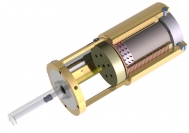
The new MIT developed needle-less system

This is not the first time that such a development has been publicized, but a technological and practical leap forward has been made. The MIT system is new in that it can deliver medicine at different depths. This means that medicines can now be inserted into muscle or fatty tissue at will and with ease.

The system uses magnets to achieve delivery, and this is the breakthrough that makes the system so interesting. Needle-less systems have been available for some years now, but they tend to rely on compressed air and are not flexible in terms of pressure. They medicine enters the body but the depth is not variable.

The MIT device works electrically and the pressure is absolutely flexible, allowing the operator to change the pressure of entry but then also lower it to enable distribution to the surrounding tissue. In other words lower pressure can be used to pass through the skin of a child, a process that does not require the same force as passing through an adult’s skin. The pressure can then be lowered to enable the distribution of the medicine to the surrounding cells once already in the body.

This breakthrough means that medication can be passed through other parts of the body too, for example through the eye tissue and directly into the retina or through the ear drum.

As you can see the importance is not really in my dislike of needles but in the loss of the needle.

Needle injuries are common for health workers, and with this system they are removed from the equation once and for all. No more accidental cross infections!

There are also obvious advantages for people that have to inject themselves daily for example in the case of diabetes.

Several major drugs companies have expressed an interest in developing and marketing the product so it looks like the days of the needle might be numbered.

I don’t know if it still hurts a bit though.