Commercial Drones and Privacy

A couple of years ago I wrote an article on the Bassetti Foundation website about the use of drones and other robot devices in warfare. Times have moved on however, and now drones are much smaller and cheaper, so you do not need a multi-billion dollar budget to buy one.

a quadcopter drone

A commercial quadcopter drone

To give you an idea, $600 US will buy you this quadcopter. Perfect for the beginner, plate already mounted for the camera and can also carry a small payload.

If you want something that resembles an aeroplane why not take a look at  the CropCam (before it takes a look at you). $6999 I grant you but a fine machine. Hand launched it is guided by its GPS navigation system, automatically lands and takes pictures, flies at 60 Km an hour and can be fitted with a video. You set up the GPS and the autopilot does the rest.

As the name suggests, this vehicle is aimed at the commercial market, look at your crops, find your animals and catch your daughter in a haystack with the boy next door.

The haystack incident might sound like a joke but it is really a serious problem. There are no regulations about where you fly your new machine in the USA. The market for Unmanned Aircraft Systems (UAS) is in massive expansion as farmers, security companies, private detectives, news organizations, traffic and transport management companies and many others see the potential in such snooping power. The machines can be fitted with face recognition software, thermal imaging and license plate readers, and many see this as problematic.

A couple of months ago the Association for Unmanned Vehicle Systems International (AUVSI) launched a code of conduct for the industry, in the light of a new law in the USA that allows anyone to operate one of these systems (see the Federal Aviation Administration Modernization and Reform Act of 2012).

Privacy groups are up in arms however, claiming that the mass use of this type of technology will lead to massive infringements upon personal liberty, and they take no comfort from the code of conduct. Voluntary as it is, the code is extremely general, has no enforcement mandate, contains no discussion at all about the myriad potential privacy and safety issues raised by unrestricted drone use over U.S. airspace, and there is nothing about the intended audience or user.

One US Senator however is trying to take action. Sen. Rand Paul has introduced a bill that aims at protecting Americans against unwanted drone surveillance. Read about it here.

The present regulations state that 400 feet above your house you enter neutral territory, a bit like international waters off the coast, so anyone has the right to fly their drone 401 feet over your house. These machines are small so you probably wouldn’t notice it, but as we know cameras are good nowadays. At a few hundred dollars for a vehicle they are becoming available to almost anyone, and certainly any business or organization.

Do you think this could become a problem? Is it yet another invasion of privacy or a justified use of technology? I am all ears.
Is Windows 8 an attempt to create a united Windows?

It has been nearly two weeks now since Microsoft released its latest operating system: Windows 8. Windows 8 is probably the most extreme overhaul Microsoft have given its operating systems to date.

It would appear that Microsoft’s aim is to unify all devices with one standard operating system – which works on desktops, laptops, smartphones and tablets. Since the launch of Windows 7 just over three years ago, tablets have revolutionised the technology market – when Windows 7 was being developed, they didn’t exist. Windows Phone – the mobile operating system family – was also not around when Windows 7 was launched.

Until recently, the general perception of Microsoft was that it was falling behind in the rapidly evolving technology industry. Microsoft appear to have been aware of this, and that is reflected in the changes and developments they have made with Windows 8.

Tablets and smartphones are becoming widespread and more heavily depended upon than ever before, so Microsoft has moved to ensure that its new operating system works seamlessly with all our devices.

To do this the firm has simplified the range of operating systems that it offers. If you wanted to purchase Windows XP, then you could choose from XP Home, Professional, Media Center Edition and 64-bit Edition – among others. Vista made the choice even harder with Starter, Home Basic, Home Premium, Business, Enterprise, Ultimate and then other 64 bit variants to choose from. Windows 7 similarly offered many different versions of what is arguable the same operating system – give or take a few features.

Microsoft Windows 8If you want to buy Windows 8, your choice is much simpler: Windows RT, Windows 8 and Windows 8 Pro. Microsoft believes that those three variations of Windows 8 are all the consumer will ever need, no matter what their device or needs. Windows 8 and its three variations will (Microsoft believes) cater for all uses of the operating system (e.g. educational use, entertainment use, business use, etc.) and all devices that you might want to use it on – i.e. tablets, smartphones, desktops and laptops.

Windows 8 is a bold move by Microsoft, and it appears to be working for them – at least at the moment. I get the perception that the industry is a little taken aback by the release.

Major Features

There is no-doubt in the fact that Windows 8 is a major change from the operating systems we are used to from Microsoft, but what are the most notable changes?

  • No start button – for the first time since its introduction in 1995, Microsoft have decided to remove the iconic start button from the operating system. It is possible to get the button back if you want, but its not how the operating system is designed.
  • Touch-enabled – all three variations of Windows 8 are touch screen compatible. If your computer supports multitouch, then you will be able to control your PC via touch! All versions also support the conventional mouse and keyboard.
  • Cross device compatibility – Windows 8 can be run on tablets as well as laptops and desktops.
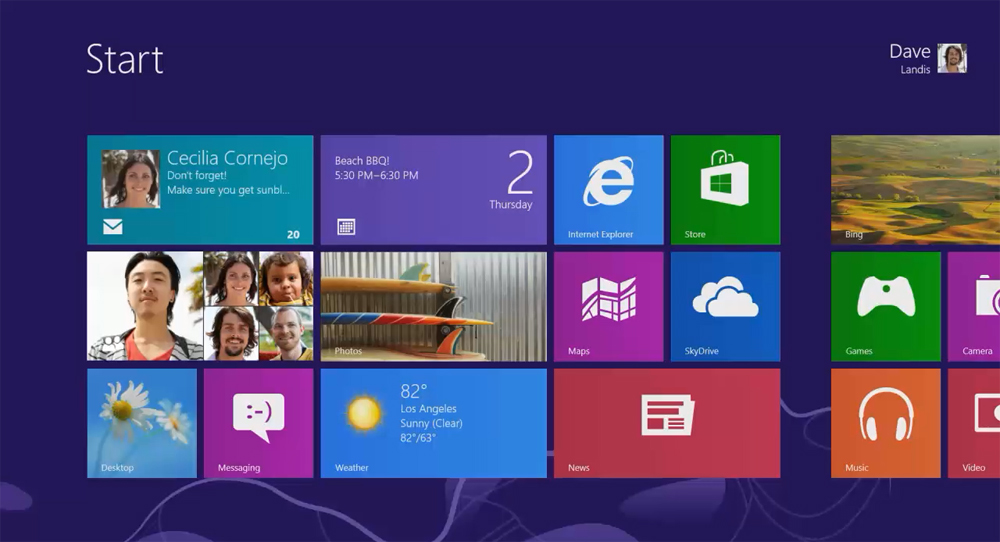
  • Tiles replace the desktop – no longer does the operating system revolve around the desktop, as it has done for so long, users now access software and applications via a start screen which is a series of ’tile’ style menus – similar to the way many smartphones operate. Windows Phone 8 and Xbox also run a similar tile welcome screen interface. The desktop is still there, just not the main focus.
Windows 8 tyle start screen

Windows 8 new tile style start screen

So, what do these changes mean to me and you? Well it would appear that there is a really big move towards more integrated, purpose built systems, or as they are starting to become known all in ones. This is mainly due to the touch screen capabilities that Windows 8 offers.

Devices which need fewer input devices (like mice and keyboards) and have inbuilt screens are really those best suited to Windows 8. If you want to see some examples, take a look at some of the all in ones from Ebuyer.

What are your thoughts on Windows 8? Do you like the idea of a more united Windows, or do you prefer your devices to work independently?

Hurricanes, Natural Disasters and Science

EDITOR NOTE: Congratulations to Jonny, this is his 50th post on Technology Bloggers! Feel free to thank him for his fantastic contribution to the blog with a comment 🙂 – note by Christopher

This is my 50th post and I am very pleased, so once again I would like to try to propose something a little different.

This week I have experienced my second hurricane, Sandy passed through Boston where I currently reside, tearing up trees, bringing down power lines and bucketing tons of water upon us. The disaster seen in New York was not replicated here, but we are still in a state of emergency with millions of people without power.

One interesting aspect about the whole affair was watching the state prepare for something that it could not really fully understand. The authorities did not know where the hurricane would hit land, or how much damage it would do. They had to rely on scientists’ models and experience to make plans and try to save lives and limit damage.

Car crushed outside

A car crushed by a fallen tree on our street

Which all brings me on to the topic for today’s post, scientific advice.

Another disaster is in the news this week from my other home country, Italy. 6 of Italy’s leading scientists and one ex government official have received prison terms for offering falsely reassuring advice immediately before the 2009 Aquila earthquake. They were each found guilty on multiple counts of manslaughter after more than 300 people died in the catastrophe. The BBC has a short article on the proceedings and sentence here.

All members of the National Commission for the Forecast and Prevention of Major Risks, they were accused of having provided “inaccurate, incomplete and contradictory” information about the danger of the tremors felt ahead of the quake. There had been a series of smaller tremors in the weeks and months preceding the larger one on 6th April, but the Commission had suggested that this did not mean that a larger quake was on its way.

They were wrong however, but many members of the scientific community have come to their defense, stating that earthquakes are inherently unpredictable, technology does not allow accurate prediction, and that a series of tremors such as those seen in Aquila only lead to a major quake on about 1% of occasions.

The Scientists found guilty are amongst the most respected geologists and seismologists in Italy, and this leads me to ask several questions. Who can we ask for advice in order to prepare for disasters if the best scientists are not able to provide the answers? What effect will this ruling have upon the scientific community and their willingness to give advice on such matters? Can we hold scientists responsible for such events? What effect does politics have on their decision making and advice to the public?

Here during hurricane Sandy several local government officials were criticized for not implementing evacuation procedures that were called for by central government upon advice given by scientists, and I would ask if the fact that there was loss of life might have been avoided. We all knew it was coming!

These points above could also be made about other problems, the obvious one being climate change. There are several articles on this website that address this issue including my own ‘Health of the Planet‘ series, but once more the entire subject is bogged down with political versus scientific arguments.

We are talking about risk here, and risk is not an easy thing to assess or to communicate. The Aquila scientists may argue that the 1% risk is minimal after a series of smaller shocks, but the risk may also be greatly magnified from a starting point of no shocks. A great deal is in the phrasing, and phrasing may be political.

Last year, here in Cambridge Massachusetts, I interviewed our local Congressman, Michael Capuano on the problems of making political decisions regarding science, and you can see a transcription here if you like. It makes for interesting reading.