The End of Blockbusters and New Start-ups?

Out with the old and in with the new once more. Last month it was Blockbusters, the global giant of video rentals, closing their last few doors for the last time in the USA, as they filed for bankruptcy. Technology has overtaken them, their model of offering films for rent is obsolete.
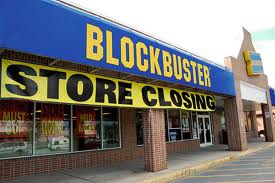
Many stores are closing

Many stores are closing

Even in the UK where I grew up there seemed to be one on every corner. I used to walk round of an evening and thumb through the Betamax section (my mum had Betamax, much better quality than VHS, not widely used in a domestic setting but still used today for broadcasting).

For youngsters reading this article, the idea was that you take the film home and watch it and then return it the day after. Yes I know it sounds ridiculous, but if you forgot to return it you paid overdue fees, and these alone made $800 million in the year 2000, and that was less than 20% of the company’s operating profits!

And the rise was incredibly fast. In its first 15 years of operation Blockbuster grew from nothing to more than 9000 stores, even today it still boasts 3000, although they have been losing money hand over fist for more than a decade.

Netflix put an end to the party, but how could such a giant in the entertainment industry miss out on an opportunity to move forward. Back in 2002 they could have bought the Netflix operation for next to nothing, but the then CEO never thought it would take off. How wrong could he be?

Well here in Cambridge Massachusetts they have devised a system in order to try and stay on track with such developments, although I am not sure it is a good one. There is a huge culture of start-up funding, with an entire industry revolving around funding such new ventures.

We have the Mass Challenge competition that gives away more than a million dollars a year, loads of networking meetings and funding workshops. But what are these investors looking for? They are looking for the next Netflix or Amazon obviously, and they are prepared to put large sums of money into anything that looks like it might develop into something of the sort.

There are a lot of start-ups here that manage to spend a million a year for several years without ever turning a profit. A few hundred thousand on lawyers each year, nice office space, public presentations, and the investors keep coming in looking to make a fortune on the next new thing.

Just to give an idea of how much money is invested if we take a look at Mass Challenge they have invested $472 million in the last 4 years, and that has made a return income of $194 million. This investment has created 3928 jobs although we don’t know how many of them exist today.

All well intentioned I am sure but that means they have so far lost $278 million in 4 years. But they have created jobs, although at a cost of almost $71000 each. Not a great return, but we are talking about a not for profit organization investing private money so presumably everyone is happy.

I just wonder whether a more efficient model could be found, while not missing out on the next best thing of course. And I wonder how ethical investment choices are made. We are dealing with huge resources, and resources are the key to shaping the development of society. How much of this money could be said to be invested for the good of society? And how long can this type of approach continue whan 3 out of 4 fail?

I should just add that I use Zipcar, a local car sharing start up, so I don’t want to sound too critical. They have taken many cars off the road, which can only be a good thing. Several other food start ups work for social good, but they feel cut out of the funding cycle. See this post I wrote for IX about their positions.

The Future of Personal Transport

I am a cyclist myself. I don’t have a car here in the USA, although I do have one sitting on the drive in Italy. The problem with cars is not only that they pollute but also getting stuck in traffic.

When I go out on my bike I know exactly how long it will take me to do my trip, presuming that I have done it before. So I can get to my music lessons in 25 minutes, or to the dentist in 20. If I take a car though sometimes it takes 10 minutes, but sometimes it takes half an hour or more, so I have to leave with ample time to adjust for these problems.

Oh and a million people a year are killed in cars, although biking is certainly no safer. What we need is an alternative, and today for you ladies and gentlemen (and third Gendered) I have started saving up for my answer and dream, a flying car.

The Terrafuggia flying car as a car

The Terrafuggia flying car as a car

No longer the stuff of dreams, local Massachusetts company Terrafuggia are now taking orders for their series of flying cars that will be launched in 2015.

A prototype exists already, and in this CNN video we can see the CEO driving it to the gas station, filling up and taking it for a fly. At a little over $275 000 it may not be in everybody’s price range, but could this seriously change the way we move around in the near future?

I think the USA is the perfect place for such a machine as there are plenty of open spaces for take off and landing, but I can’t see them selling many in Hong Kong or Singapore, or even my home city of Manchester to be honest.

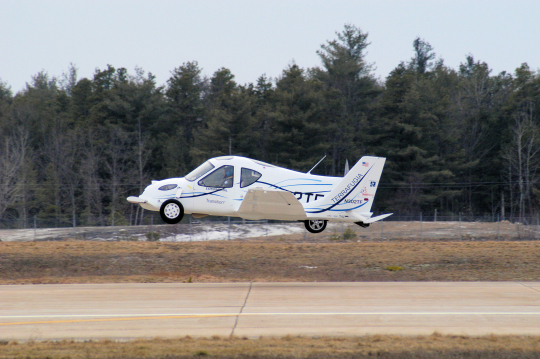
The Terrafuggia flying car as an aircraft

The same Terrafuggia flying car as an aircraft

But returning to the craft itself the spec is interesting. As the website states “the Transition® is the transportation of the future today.  A street-legal airplane that converts between flying and driving modes in under a minute, the Transition® brings a new level of freedom, flexibility, and fun to personal aviation. It gives the pilot the option to land and drive in bad weather, provides integrated ground transportation on both ends of the flight, and fits in a standard single car garage at home.  The Transition® can fly in and out of over 5,000 public airports in the U.S. and is legal to drive on public roads and highways. It is the only light aircraft designed to meet Federal Motor Vehicle Safety Standards, and it is also equipped with a full-vehicle parachute for additional safety”

It can fly 500 miles on a single tank of gas, travels at 100 mph, has automated landing capability, is equipped with a parachute in case of emergencies and you can learn to fly it in less than a day.

The company is also working on an electric vertical take off craft, but this is still in the design stage.

I like the idea, what do you think? No more ice cream for the kids, health club for the wife or golf for me and I reckon that by the time I’m 60 I could buy a second hand one.

Yawn Free Coffee

Colourful

EDITOR NOTE: This is Jonny’s 100th post From his humble beginnings writing about elective amputation, Jonny has taken Technology Bloggers by storm! Jonny started as a contributor, soon after earning himself author status and he has recently been awarded editor status. Congratulations and thank you from me and the rest of the community Jonny, you deserve it. Here is to the next 100! 😉 – note by Christopher

Oh I am rather tired this morning, like many others. I need to have my daily coffee. Sometimes I imagine a world where my surroundings understand me, my needs and wishes. I had a teas-maid once, that was the closest I ever came to automated good life, but times have moved on.

Face recognition software offers the dream of a newly serviced life. And the dream is here already, well not here exactly but in South Africa.

Yes coffee producer Dowe Egberts have built a coffee machine that uses a camera and software that can read your face. When it sees a person yawn it automatically produces a free cup of coffee for them. Check out this video on Youtube. Or get a free coffee by yawning next time you pass through the O.R. Tambo International Airport.

This is of course all done for publicity, but it does open up a train of thought that leads into science fiction.

This is not my first post about face recognition software. I wrote one earlier this year about Verizon’s project to fit it to TV top cable boxes, and the year before about mobile recognition apps, and since then there have been a few developments that I would like readers to note.

Researchers have been working on identifying individual animals using the same software. Cameras are often used to count wildlife in studies, but the problem often arises of determining which animals may have been counted twice. This problem could be overcome if the software could recognize the individual beasts, and scientists at Leipzig zoo have been working on such a project.

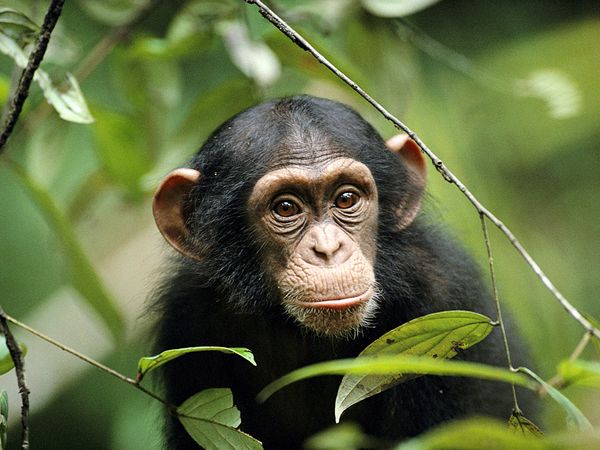
Do you know this one?

Do you know this one?

They have 24 chimpanzees to work with, and have designed a system that recognizes individual animals with up to 83% accuracy. The difficulty is getting good photos in the wild though, and in dim light the accuracy quickly drops, so the researchers have been designing new parameters to improve broader recognition.

Check out the article here to learn more.

On a slightly less positive note Facebook are again at the helm of recognition privacy. Once again, proposed changes to its privacy policy mean that already uploaded information is to be used differently.

Facebook has indicated that it will now reserve the right to add user profile pictures to its facial recognition database. Currently, only photos that a Facebook friend uploads and tags with a user’s name go into the facial recognition system. By opting out of the tag suggesting feature and declining to allow friends to tag him or her, a user can avoid being included in the social network’s facial recognition database.

No More might this be the case!

The change would mean that every user, of a population of a billion, whose face is visible in his or her profile photo would be included in the database. To sidestep the new feature, users will have to avoid showing their faces in their profile photos and delete any previous profile photos in which their faces are visible.

Facebook have however had problems implementing their recognition policies in Europe, and in fact the system was turned off in August of last year, but the new regulations seem to be another attempt at opening the door. See this article for a review of the arguments.

Regardless of whether you as an individual take these precaution, millions will not, and the database will grow massively overnight. And that will be worth a lot of money to somebody somewhere down the line, and have implications for all of us.