A look into the technology used in live television

Around the world billions of people watched the Olympic Games last month. In this article I am going to explore the technology that is used in order to get the live action, be it aquatics, basket ball or shooting, from the event, onto our TV screens.

Live TV is a little different to recorded television. With recorded television, it has often been carefully chopped up and edited before it hits our screens. With live TV, the luxury of being able to remove mistakes isn’t there, as too much a delay would mean events were actually not live. There are a few seconds of delay between real events and what you see on your TV screen, like their is with radio, however this isn’t enough time for any extensive editing.

So imagine we are watching the men’s Olympic 100 metres final. Usain Bolt lines up along with two other Jamaicans, three Americans, a Trinidadian man and a Dutch man. The starters pistol blows and then what?

Well there is a lot more video broadcast equipment involved than you might think!

The Camera

The first part of the chain is the cameras. These capture all the events first hand. At an event like the Olympics, there will usually be tens, and sometimes hundreds of cameras, and a good broadcaster will always try to keep them out of shot of each other – so you don’t get a camera panning to a shot which features another camera in it!

The camera may be free standing, or it could be on a dolly or a jib. A camera dolly is effectively a track that the camera sits on, so that it is able to move smoothly to capture moving action. A jib is a device which has a camera on one end and a counterweight on the other. A jib allows a camera to be moved freely around an area. When you see a swooping style shot on television, that will usually have been achieved by a jib.
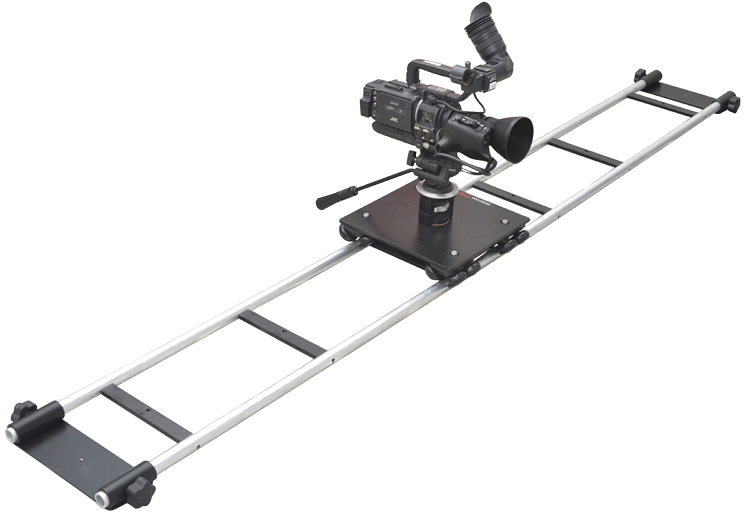
A camera on a track

A camera dolly

The camera will have various different wires coming out of it which will ultimately lead to a monitor. Behind the monitor will be a director who decides how and where the camera is to move to get the best shot.

The Mixing Desk

The camera will then link into a mixing desk, which in a live event like the Olympics will usually be in a really big, extremely technical looking van. Inside the van will have a number of operators choosing which of the hundreds of buttons to press, and which shot should be used – don’t forget there will be loads!

This van will control the stream of visual and audio footage that is send to TV sets across the area, country and possible the world. Sometimes the format of the stream may have to be changed. To do this a digital media streamer is usually used. To see an example of what a digital media streamer looks like, have a look at the Sencore website – under the Signal Sources tab.

Once the finalised stream is ready, a great big satellite dish on top of the van (the one with the mixing equipment inside) will transmit the stream to a satellite high up above the earth.

The Satellite

The satellite then sends the signal to all the local masts where the stream will be broadcast from. These masts are usually called television masts and are often really tall thin metal structures with a flashing red light on top – to warn passing aircraft.

Your House

The television masts are transmitting the signal far and wide, and your areal on your roof will pick up this signal. It will then pass down the wires in your house and after an exchange box reach your TV, where thanks to either LEDs, plasma, or some other means, you will see Bolt steam to victory!

If you have a satellite dish the process is slightly different as you receive the feed directly from the satellite. Also if you have a portable aerial, you bypass all the wires in your house.

So, that is how a live event reaches your TV screen, and it does all of that in less that 30 seconds. Pretty amazing don’t you think?

Data Storage Problems

This week the New York Times published a long article about the problem of data storage, and I would like to summarize some of their findings. The article is available here in Saturday’s technology section.

The article is an attack at what the author sees as wasteful use of resources in data storage centres. There are now hundreds of thousands of these huge centres spread throughout the world, and the problem is they use an incredible amount of electricity. The servers have to be kept cool and they have to have spare capacity so that we can download whatever we want whenever we want.

Inside a US data centre

Inside a US data centre

Worldwide these centres use about 30 billion watts of electricity, and that is about 30 nuclear power plants worth of power. A single data center uses about the same amount as a small town, and the main criticism is the nature of the usage.

In the US 2% of all electricity used goes to these data centers, but the vast majority of this resource is wasted. Typically many servers are left to run 24 a day but never or rarely used (more than half in this study), and the average machine in operation uses less than 10% of its capacity. Servers are left running obsolete programs or in ‘comatose’ because nobody wants to risk a mistake and turn them off.

All of this means that any data center might use 30 times as much electricity as is needed to carry out the functions it performs.

All of these centres also have to have a back up in case of power failure, and so are surrounded by diesel generators and stacks of batteries, and many have been found in breach of environmental regulations and fined. The article gives details but the companies are names that we all know and use.

If you read the more than 300 comments however you will discover that a lot of people do not agree with the findings as reported. Many technicians argue that the companies cited are investing huge amounts of money into making the storage of data more efficient, and are constructing wind farms and using solar power in an attempt to cut costs and emissions. The article has its agenda and exploits it fully, but the problem is real.

I personally believe that we are witnessing the results of a digital culture change. We no longer have to store data on our machines, we can store it in some mythical cloud out there in the cyber-universe. This makes us think that it somehow exists without the need for a hard drive, but this is not true. As a result we keep things that we do not need. I have 500 e mails in my inbox, with attachments, photos that I will never again look at and other useless things, and they are all in storage somewhere.

Technology advances, storage gets cheaper and uses less space, but the amount of data created is growing at an incredible rate. My question is, can we do anything about it? Are we not the ones who should take some responsibility and think about the consequences of our actions. We think about not using paper to print emails but we don’t think about not sending them!

Smarter Cities

Following on from my post last week about Apps and Christopher’s post about smart skies on Tuesday of this week I would like to introduce smart cities. Harvard University graduate School of Design run a course that they describe as Urban Cybernetics, called in fact Smart Cities. It is taught by Nashid Nabian, and the aim is to design urban projects that use technology to improve urban life.

The final projects are available to browse online through the course website, and many are very interesting. Cameras and sensors are some of the tools of the trade, used to measure pedestrian or cyclist use of the city, to improve traffic flow or better understand the mechanics of the city from a host of other points of view.

One of my favourite projects is called The Listening City and was written by Carolina Soto within the Real-time Cities course in autumn 2011 as part of the Responsive Environments and Artifacts Lab. Her project involves the use of QR codes that can be scanned using a smartphone. The codes are attached to street furniture, dustbins and all types of functional objects for the running of the city. If a passer by wants to report a problem with any of the objects, they just have to scan it with their smartphone.


An example of a QR code in use

A QR code on a traffic signal in Cambridge MA

Once scanned, the user is lead to a website where they complete a questionnaire related to the functionality of the object (in the case of a dustbin if it is full or empty etc, or for a pedestrian crossing light if it works or not).

As the position of each code is known the problem can then be signaled on an interactive map, with the data centrally collected so that it can be analyzed and patterns discovered that may help in improving services.

Take a further look and watch her slide presentation here.

Design and designers affect almost everything in our lives, and working towards improving city life through technology seems like a great idea to me. We are talking about real life improvement that can be seen and measured, information about which bins fill and overflow first is important, the city can be redesigned to confront the problems caused. It might also create solidarity within the residents, more participation in civic life and resolve some of the niggly issues that urban living throws up.