Eight tips to consider before building a mobile websites

With over 75 million Americans accessing the web through mobile phones, we can conclusively say that mobile web browsing has come to stay. comStore statistics recently reported that 50 million people in the United States have an Android, iPhone or a BlackBerry phone.

The Logo of BlackberryWhat these huge numbers clearly mean is that your business can not afford not to provide a mobile website for a convenient browsing experience for your customers. Mobile websites are starting to become a ‘must have’ for any kind of business today.

The rate at which people are accessing the web today throughout the world from their mobile phones is becoming increasingly clear that any business that wants to remain in business must leverage the opportunity of mobile browsing. It is easy, cheap and quick to do it today; in fact, some web design companies render this service for free. But before you decide modifying your existing website to make it compatible for mobile handsets, put these things right:

1. Page Size

It is important to assign a simple style for all mobile websites, the page size also small. Remember that 20KB is the maximum page size for all mobile friendly pages. If you can use less than 10KB making everything nicely fitted for any kind of phone, considering that users are charged per KB of mobile data you will be doing your business good.

2. Coding

There is actually no special coding required for mobile websites. Using XML or XHTML for your mobile friendly site is much easier and faster. Using basic HTML and CSS is also good. Carefully craft with target key words the filenames, title tags, heading tags and description meta tags to fully maximize the optimizable content present.

3. Content

There is actually no special way to arrange content for mobile websites. The rule is simply-all mobile websites should be readable and easy to navigate, since your visitors are on the go and may not want to waste time on something difficult to read or surf. As for the content typography, it is preferable to use headings to control the font size.

4. Images

Most mobile phones take longer time to load images. Use graphics and images as little as possible only where necessary, this will aid easy navigation for your mobile website users. Jpeg, gif or png are best formats for mobile images because they are very much light–weight. Compressing your pictures to avoid zooming is something you must not forget.

5. Layout

Mobile browsing is quite time consuming, so ensure you put all the most important information you want your mobile website users to see on the top of the page your company logo should be included as well. Left and right navigation should be minimized because it is difficult navigating with a phone.

A better option is to arrange all your content in a single column. Tables should not be used, but if necessary no more than 2 columns, rows and column merging should be avoided.

6. Page links

Back buttons and links are features of all good mobile websites. Providing them will help visitors escape dead ends, though, not all phones are designed with back buttons.

7. Domain Choice

Ensure to use a mobi domain which clearly indicates a mobile friendly experience instead of .edu, .com, .org etc, which generally stand for desktop browsing.

8. Test Run

Your mobile website should be tested on multiple devices. This will help you know if your site will provide a good mobile experience for users.


How does Google make money?

The other day someone asked me how Google makes its money. At the time I called upon the knowledge I had and talked about the ads they have in the search results, the Chromebooks and Android systems they are selling, and Google Apps and Docs.

This week Google announced, it was disappointed with its 27% rise in revenues. Yes you read right, it was disappointed! Profits were up 6.4% and revenues 27%. In the same period, (the last quarter of 2011) Microsoft saw its revenues rise just 5%, and its profits fall by 0.15%!

Here is the interesting (weird) thing, Google’s share value fell 10% after the announcement, whilst Microsoft’s grew by around 2%! How crazy.

Anyway, this got me thinking, what are all the way Google makes money, as that is a lot to get just from the ways I mentioned.

How does Google make money?

The fact is, the majority of Google’s revenues come from the ads it presents to users on search result pages. However in recent years it has started making more and more money in other ways. So what are these other ways Google makes money?

Chromebooks

Introduced mid last year, Chromebooks are laptops powered by Google Chrome OS, where the laptop and the internet are one. There are no programs, desktop or start menu, the who experience runs from the cloud, utilising all Google’s (and other) online applications.The Google Chrome Logo

Samsung and Acer are the two firms which currently offer Chrome OS powered laptops, however expansion to more brands in the future is inevitable. Samsung and Acer obviously take their share the sales, as will Amazon and the other places Chromebooks are sold, however the laptops do make money for Google.

Android

I assumed that Google made money from Android, however I was wrong – Google does not make money from its Android mobile operating system. Android is a Google-led open source mobile OS framework, however Google does not profit from it.

Google Android's Logo

YouTube

Since Google bought YouTube in 2006, the site hasn’t been that profitable for it. YouTube is now the site with the third most traffic on the web, meaning that it has huge potential, however until recently, it was only making money from ads.

Before Google AdSense ads used to appear alongside videos, which they still do, however now they also advertise within videos too. Furthermore, YouTube have started offering online movies, which users can pay to watch from the comfort of their own home – or wherever they are.

Google Storage

Many Google services offer online storage, however this is only a finite amount. Should you want to purchase extra storage for Gmail, Google Docs, Picasa or Blogger (photos on blogger, not posts) then you can do so from Google Storage. I doubt this brings in Google a lot of revenue, but nerveless, it makes the internet giant some money.

Google Store

Google have an online store which distribute to may different locations around the world. They sell everything from branded keyrings and juggling balls, to t-shirts and even accessories with past Google Doodles printed on them.

DoubleClick, AdSense and AdWords

The majority of Google’s revenues come from the advertisers who use AdWords and DoubleClick. These ads are then either shown in the search results, or on websites which host AdSense units. Google makes lots of money out of ads. It doesn’t tell AdSense hosts what cut of the advertisers fees they get, but it makes Google a lot of money, so I would guess that they take home more than website owners hosting their ads.

Other Ways Google Makes Money

These are not the only ways Google makes money, other ways include, Google Apps for Business, Google Cloud Connect, Google Docs, Feedburner (through ads), Google Earth Pro, Google Mini (where you effectively buy the Google search engine to use on your own site/intranet), Google Checkout and more.

Hopefully this gives you some insight into just how many ways there are that the search giant that is Google makes money.

Is cost and pollution free power already here?

In this the fifth post in my series I will introduce some of the inventions that claim to produce free and/or pollution free energy. I would like to make it clear from the outset however that I do not know whether these techniques actually work. Many of them have been patented, some replicated and some demonstrated several times. Some defy the accepted laws of physics. Some have been proven false.

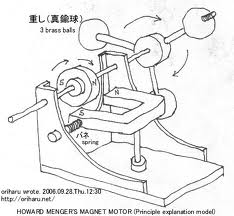
The magnet motor promises free endless power

The following examples are just a few drawn from dozens found on the internet.

The patenting of machines that claim to harness energy directly from the atmosphere has a long history. At the turn of the 20th century Nikola Tesla registered several patents for inventions of this type. One particularly simple device is known as his ‘aerial device’. It is something like a large insulated sheet of metal with a capacitor and transformer attached below it. The metal plate vibrates, possibly due to static and the capacitor is charged. The transformer lowers the voltage and the current can be fed into the system. It works day and night and the size of the metal sheet determines how much power is produced. Tesla’s biography is here.  As you see he was not a crank, without his work we would probably not have computers today.

Tesler’s invention might be described as producing free energy, and this is certainly one aim for inventors of these types of objects. Another objective however is to build a machine that produces more power than it uses to operate it. Simple enough, I use 10 units of power to make the machine work, and the machine provides me with 11 units of output, or more. There are several machines that claim to succeed in this goal. It even tells you how easy each project is to construct, how well it is likely to work and how reliable the ideas upon which it is based are.

First to free energy. The internet is full of demonstrations of magnet motors and how to build them. This video is an example. The builders claim that using only magnets they can build a motor that spins without any external force being applied. A quick search will find plans and detailed explanations of materials needed and results expected. The only problem seems to be that the results are ‘physically unexplainable’ and many people say impossible. Are these machines fraudulent? I would love to know, because if they are not then it looks like clean electricity is possible today.

Other systems involve using different types of fuel from those conventionally thought of. A current example is the claim made about recent successes in what we in the non-science world call ‘cold fusion’ and is correctly termed a low energy nuclear reaction.

Early last year engineer Andrea Rossi and Physicist Sergio Focardi built a machine in Bologna Italy that they claim can produce huge amounts of power without polluting or causing radiation using only nickel as a fuel. The nickel is turned to copper during the process (proof of a nuclear reaction taking place) but only tiny amounts of fuel are used. There is however an undisclosed secret ingredient to the operation, and Rossi will not divulge his secret to anyone, including Focardi. The two demonstrated the machine on at least 2 separate occasions last year and are currently constructing a huge version for trials later this year. See this article on the Bassetti Foundation website for a fuller explanation and links to a video of their demonstration.

The water powered car is another thing to look at, and has been in existence for many years. There are several videos on the Internet demonstrating converted internal combustion engines that run on water. In this video inventor Paul Pantone demonstrates his “GEET Plasma Reactor Motor”, explaining how it works and showing it running. Here we get into conspiracy territory however, as the video states that after posting the video on Youtube the inventor was arrested and denied medical therapy while under arrest. There is an implicit claim that those in authority did not want his invention to be made public, but this is not backed up by any evidence however.

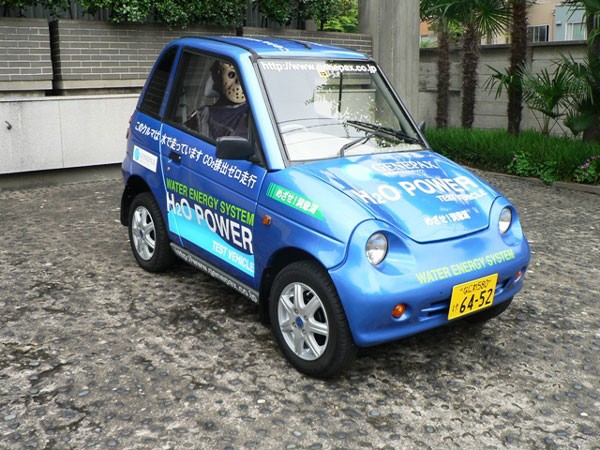
A related story is of the guy who invented a car that ran on water in the 1980’s.  Stanley Meyer built a sort of dune buggy and the Pentagon reportedly showed interest in his invention.  He died in strange circumstances however in a car park outside a restaurant in Ohio in 1998, probably poisoned. Some (as this video demonstrates), go as far as to say that he was murdered by the state but again without providing evidence, but the conspiracies abound once more. Several other sites claim that his car was then stolen along with all of his plans and technology, although there are several long videos and rediscovered tapes on Youtube in which he explains how the car works. As the photo below demonstrates, modern versions do exist today. This water powered car was built in Japan, watch the video on this website.

Japanese water powered car

And here to the thorny matter, many of these machines are available to buy today, well the plans are at least. The Hojo motor promises free electricity for example, but at a price, and what if you buy the plans to discover that you can’t get the thing to run?

This article describes how the Federal Trade Commission investigated allegedly false claims by a well-known inventor and character in this field named Denis Lee. They found that the promoters ‘are marketing a product that cannot exist and function as claimed’ and allowed complaints to be filed. Pseudo-science and marketing at its best we might say.

If you want to read more about these devices the free energy website will keep you occupied for days. Chapter 16 should be your stating point.

I would love to hear from anyone that has either constructed or seen any of these machines in real life. Next week I will conclude the series so speak now, of forever hold your peace!